All posts by Fergus Bisset

Making your event brain-friendly with visual note-taking

By | Examples | No Comments

This post was written by Nat Al-Tahhan.

Visual note-taking, scribing, live-drawing, graphic facilitation, graphic recording, infodoodles, sketch-noting… These fancy terms can be confusing for those unfamiliar with the discipline, but ultimately all refer to a similar practice of visualisation.

I’m Nat, a freelance designer & illustrator, and I’m going to shed some light on this form of visual communication for events, conferences, meetings and reports.

What is visual note-taking?

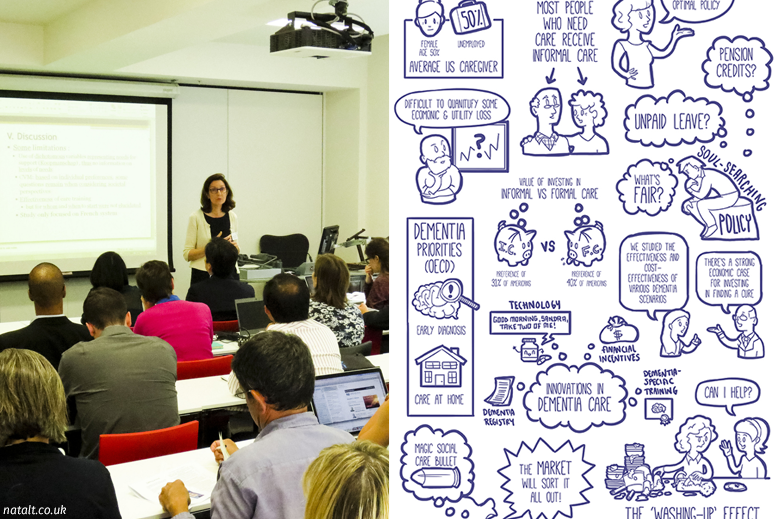
With my own method, which I call ‘visual note-taking’, the aim is to capture the essence of a conference, meeting, or report by llustrating soundbites, ideas and themes in visual metaphors.
IMG 2

Excerpt from visual notes taken at the ILPN conference at the London School of Economics.

What’s the process?

Live:

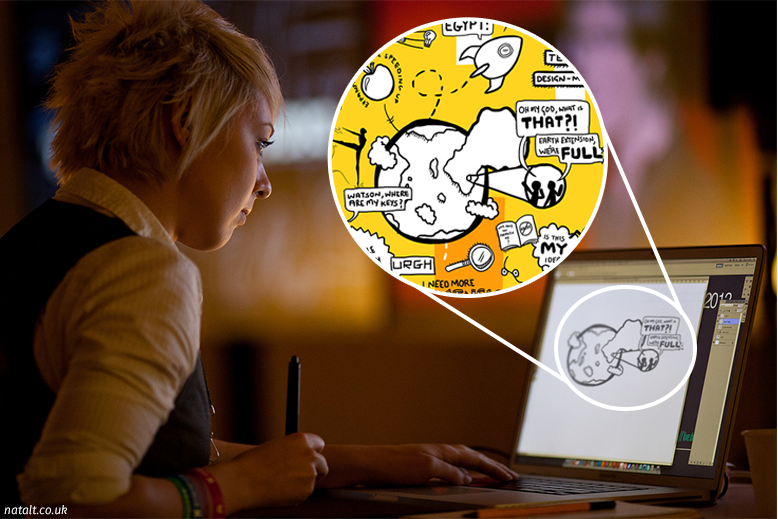
Working directly into a digital format live on the day makes for a versatile piece that can be broken up, rearranged, repurposed, and easily shared to give the piece utility and longevity post-event.

Depending on the nature of the event, work-in-progress of the piece can be projected onto a wall or viewed on a screen for delegates to browse throughout the day – this is ideal for conferences with breakout spaces and networking breaks. In addition, collaborating with social media teams to tweet/blog the work in progress and providing individual illustrations to complement their coverage is a great use of the work on the day.

Remote:

Visual notes can also be produced remotely from reports, or post-event from recordings.

The process is largely the same, but the scale of the piece can be dictated, as there will potentially be more than the duration of the event to produce it.
IMG 3

Live visual note-taking in progress, TED2012

What’s the benefit of visual note-taking at an event?

Aside from the obvious intrigue value of an illustrator drawing at your conference, having a visual representation of ideas will help with retention and engagement in your delegates.

The illustrations are accessible, highly shareable and fun to engage with – i.e. they’re very brain-friendly! They can be used to promote your next event, and when sharing with those who didn’t attend, this highly visual piece allows them to quickly get a feel for the day’s goings-on.

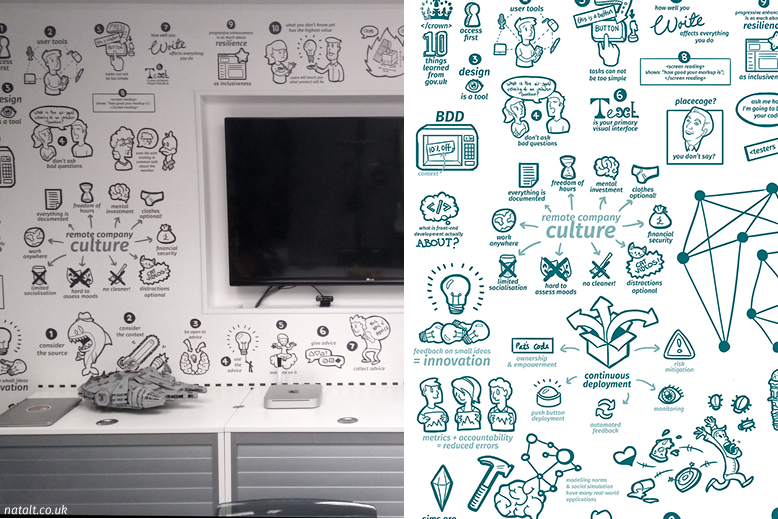
Some event organisers have been really creative with the finished pieces, including creating wall artwork for offices and spot illustrating reports and websites!
IMG 1

Wall artwork created from visual notes taken at re:develop 2014

When is visual note-taking NOT appropriate?

Due to the versatility of the medium, the practice of visual note-taking can be applied to many different event structures and even internal meetings. However, there are some cases where another form of visualisation could be more appropriate, such as very dataheavy presentations/talks – where an infographic might be the better route.

There are also times and places where it would be best not to display the work in progress at live events, such as on stage during talks, and during meetings – in these circumstances focus should always be on the person speaking, and illustration happening live is very distracting.

In summary

Visual notes are a fun and accessible way to capture and record your event, encapsulating the key ideas, themes and takeaways. When taken digitally they have a myriad of uses post-event, and can integrate with other forms of event coverage.

If you would like to see more examples of visual notes, as well as infographics and other forms of visualization, you can visit NatAlt.co.uk

Nat Al-Tahhan | @natalt

[email protected]

Welcome to the Social Care Research Impact Website

By | Impact, Research Process, Website | No Comments

Welcome to the Social Care Research Impact Website. It’s been a really interesting process designing and developing this site, which is built on some workbooks and workshops conducted as part of the SCEIP (Social Care Evidence in Practice) Project led by PSSRU @ LSE. We received strong feedback that having the contents of printed workbooks made available online would help engagement, and the development of a more engaged community of practice around the impact agenda in social care research. Hopefully, this site in its current form is the first step towards that longer term and ongoing goal.

I’ll leave other colleagues on this project to blog more about SCEIP itself and the origins of both the Impact agenda for research within Social Care and the other outputs and findings of the work that SCEIP has been doing over the last few years. You can find some of that information on the two links above. Instead, I want to introduce the website to you, which was, as one of the outputs of this project, designed as a repository of tools and methods to support researchers to consider, plan, and implement impact activity throughout their research processes.

On a slightly ‘meta’ level I suppose, but an illustrative one, the website itself forms part of the impact of the SCEIP project as a whole – a resource that lives on, even as the SCEIP project draws to an end in its current form. Hopefully, without getting too wrapped up in these different levels of abstraction of the concept of impact, the idea of the website as both an ‘output’ of the SCEIP project and an ongoing activity, or platform that communicates and continues to redefine and redevelop the findings of the SCEIP project in its own right is helpful in illustrating the concept of research impact that SCEIP is trying to support. This idea, that it is no longer good enough, or effective enough practice as a researcher to consider impact as an output at the end of the research process, and instead, that we must begin to see, and more adeptly capture the knowledge we generate, as manifest in performances, and recorded through use of the tools of impact such as those detailed on this site, as ongoing and dynamic parts of the research process itself. Put more simply, what would the world look like if every research project had it’s own blog site and published its findings in an engaging and accessible manner, freely available online?

Whilst you consider that question and it’s applicability and suitability for your own work and in conjunction with your own interests with regards to research impact and research implementation within social care, consider also that the requirements of many research funders and the wider RCUK Impact Agenda now demand that such ‘impact activities’ in fact become themselves embedded within, and enhance, the research you are conducting. Practicing impact activity in this way thereby becoming, in the current political, social and technological climate at least, fundamental to the way you as a researcher fund, qualify and evidence your work and communicate your research findings.

If you are convinced, or already aware of the need to consider Impact and utilise a web resource such as this as part of your practice as a researcher, you can find the tools we have assembled for performing and documenting impact using the menu above, assuming you haven’t already. We have two types of resources at this stage, namely Impact Tools and Impact Management Tools. These two repositories, designed to be useful to researchers in considering and planning impact activity build upon two of the findings from SCEIP that, 1. tools for impact are not clearly enough signposted for social care researchers, and that 2. the process of planning and managing the impact process is often difficult too, and a substantial barrier to success. We hope in providing a basic list of possible ways of creating, performing and documenting impact, and another resource supporting some of the ‘behind the scenes’ management aspects of these processes, we have begun to address these two identified barriers to impact for social care researchers. We welcome ongoing feedback about how useful these ‘front stage’ tools and ‘back stage’ management tools respectively are in supporting you in your research, and, we hope, assisting you in planning and increasing the impact of your research wherever you are currently working, and whatever the stage in your research you are currently at.

The design approach of thinking about impact as a process, rather than an outcome, is one of the key insights developed through the SCEIP project itself and mirrors the transition of what we now know as the ‘Impact Agenda’ from it’s previous incarnations as ‘awareness raising activity’ and ‘engagement activity’. This increasingly participatory transition, from purely didactic and static approaches of achieving impact such as journal articles, or conference proceedings towards more democratic and dynamic approaches not just to influencing or reviewing policy, but shaping the social care landscape through research from the bottom-up. This does of course open up many further questions about the motives and ethics associated with impact activity and also provokes further questions around the ethics and implicit assumptions of technology and media more generally as mechanisms for communicating and engaging people with research. I think at this point in time, however, the web is undoubtedly a fundamental tool in society in general for supporting people to use and access knowledge. However, a common metaphor we relied upon throughout the SCEIP project was the idea of avoiding research ‘just sitting on the shelf’ after it was done. The use of dynamic and social media such as websites, blogging, and social media tools as detailed elsewhere as impact methods themselves on this site, and manifest in this site itself, does not guarantee that web resources and social media won’t just become ‘virtual shelves’ gathering virtual dust, like many of the journal articles or conferences proceedings that we also produce as researchers and that are also available through the web. Addressing this point with respect to our own online resource, we are really keen that people begin to feedback how we can make this site more useful, and continue to develop ways of supporting people to both use and access it’s content, and in so doing engage with its aims. Please feedback to us through the comments below, or through twitter and we look forward to continuing to adapt and evolve this resource together with you further in future.